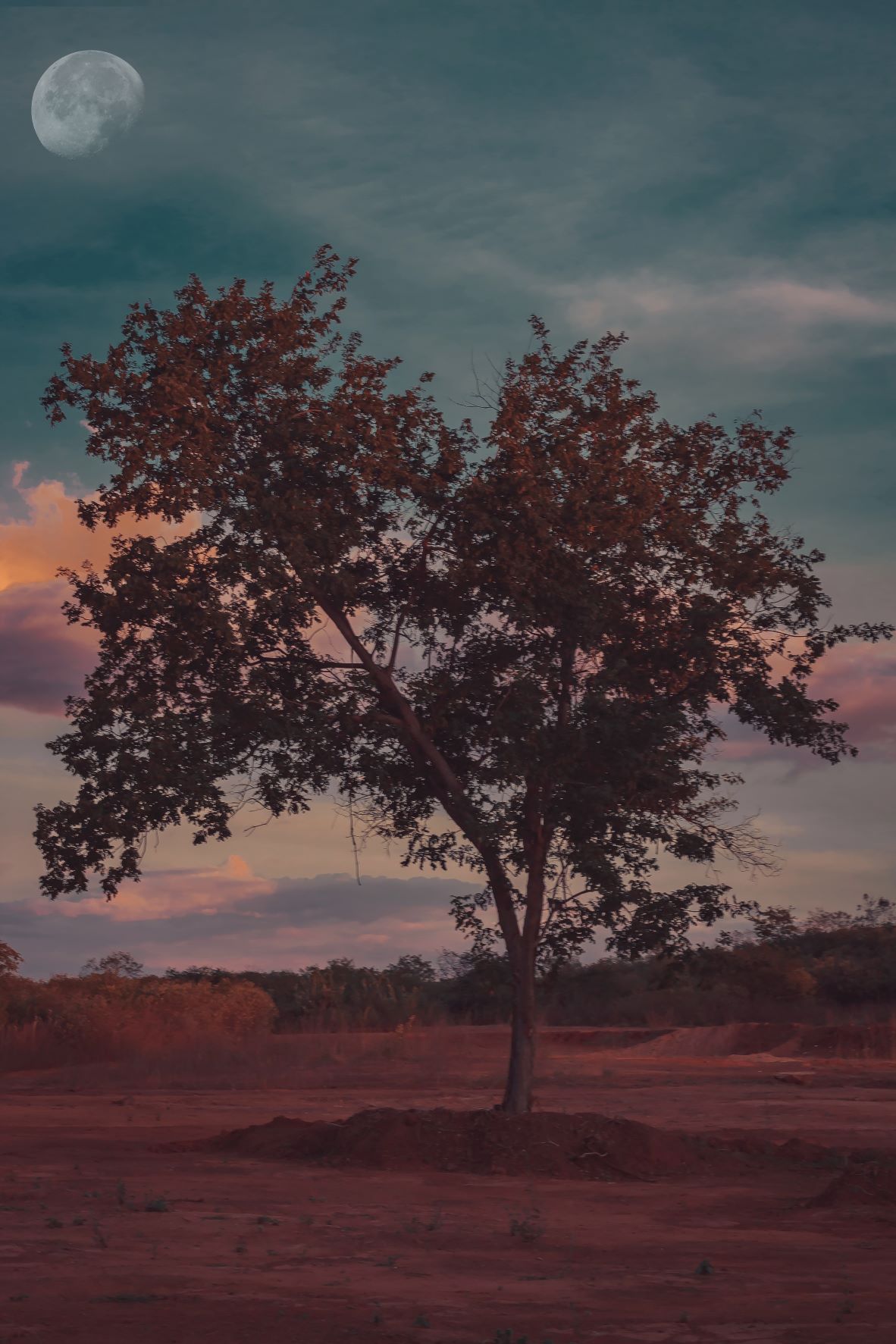
Photo by Denise Rodrigues dos Leal
The many faces of the Moon as we look upon the sky on most nights, from harvest moon to blood moon, from crescent to quarter to full Moon. The Moon remains a familiar presence in the sky.
The Moon is one of the first celestial bodies you learn to recognize. Many people consider its light somewhat unique since it can brighten the darkest corners of the night. Is it any wonder that cultures around the world revere the Moon as sacred — even magical?
There is one thing that our Moon likes to preserve instead hidden from us — it is the far side, the face we never see. This is because our rocky companion spins on its axis around the same time it takes to orbit the Earth. Though it is not always entirely hidden, the interaction between the Earth and Moon sometimes causes our satellite to rock forward and backward in a motion known as libration, revealing about 9% more of its surface and showing various halves at different times. Because of the angle of the Earth to the Moon, you would be hard-pressed to spot anything interesting on the Moon’s far side, but it is worth looking out for.
Why is the Moon considered beautiful?
The Moon represents heavenly perfection. It is perfect in its beauty yet imperfect at the same time. It is like a mysterious lover. He makes you wait every day before fully revealing itself before you. Upon seeing it in its totality, the scars it was hiding before seem insignificant before the ecstasy of beholding your lover for the first time.
Every time you look at the Moon, it captures you with a mired beauty. Its scars comfort your scars. There is an innate understanding between the Moon and you. It always shines on your totality through its bruises. The relatability is soothing. It is comforting.
There are so many ways to observe and celebrate the Moon. Here are some of the few ways to keep the beauty of the Moon.
Way #1. Looking up. The easiest way to behold the Moon is to look up. The Moon is the most vivid object in our night sky, the second most striking in our daytime sky, and can be seen worldwide.
Way #2. Peer through a binocular or telescope. With some magnification help, you can identify details on the Moon. The strip between day and night on the Moon is ideal for seeing lunar mountains and craters since very long shadows heighten the contrast of the features.
Way #3. Photography. The Moon has always been a popular subject for photographers—no wonder moon and lunar photography is so popular. But whether you are trying to take a photo of it in plain view or during a lunar eclipse, it can be very tricky to capture on camera. The Moon will typically look like a flat white circle and will be too far away to become the focus of your image.
Way #4. Relaxing at your home. You can observe the Moon from the solace of your own home.
Way #5. Through the spacecraft. The spacecraft contains many instruments to analyze the Moon’s composition and environment. One is the GRAIL spacecraft to decipher the maze of the slope map from the laser altimeter onboard LRO. This collection from LRO features images of the Moon’s temperature and topography.
Speaking of the Moon, the book “Moon Luck” by Scott Harral delves into the story of 30 astronauts living on the Moon for extended periods. It is also the story of the astronaut scientists and astronaut explorers as they grow plants on the Moon, explore and find mineral ores, conduct experiments and research, and develop animosities and close relationships.
In the coming decades, there will likely be one or more active stations permanently located on the Moon. And human life will inevitably be taken by another while people are living in these moon colonies. Will we be prepared for the first time it happens?
The Moon is big, shiny, and mysterious. It is something that can be seen but is very elusive. You can enjoy it at a distance but cannot be with it. Kind of that, the beautiful girl you are interested in but too afraid to ask out. That is how the beauty of the Moon can be best described.
 The Happy Hammock